BREADLINE BRITAIN 

BREADLINE BRITAIN

The rise of mass poverty

Stewart Lansley and Joanna Mack

Oneworld publications

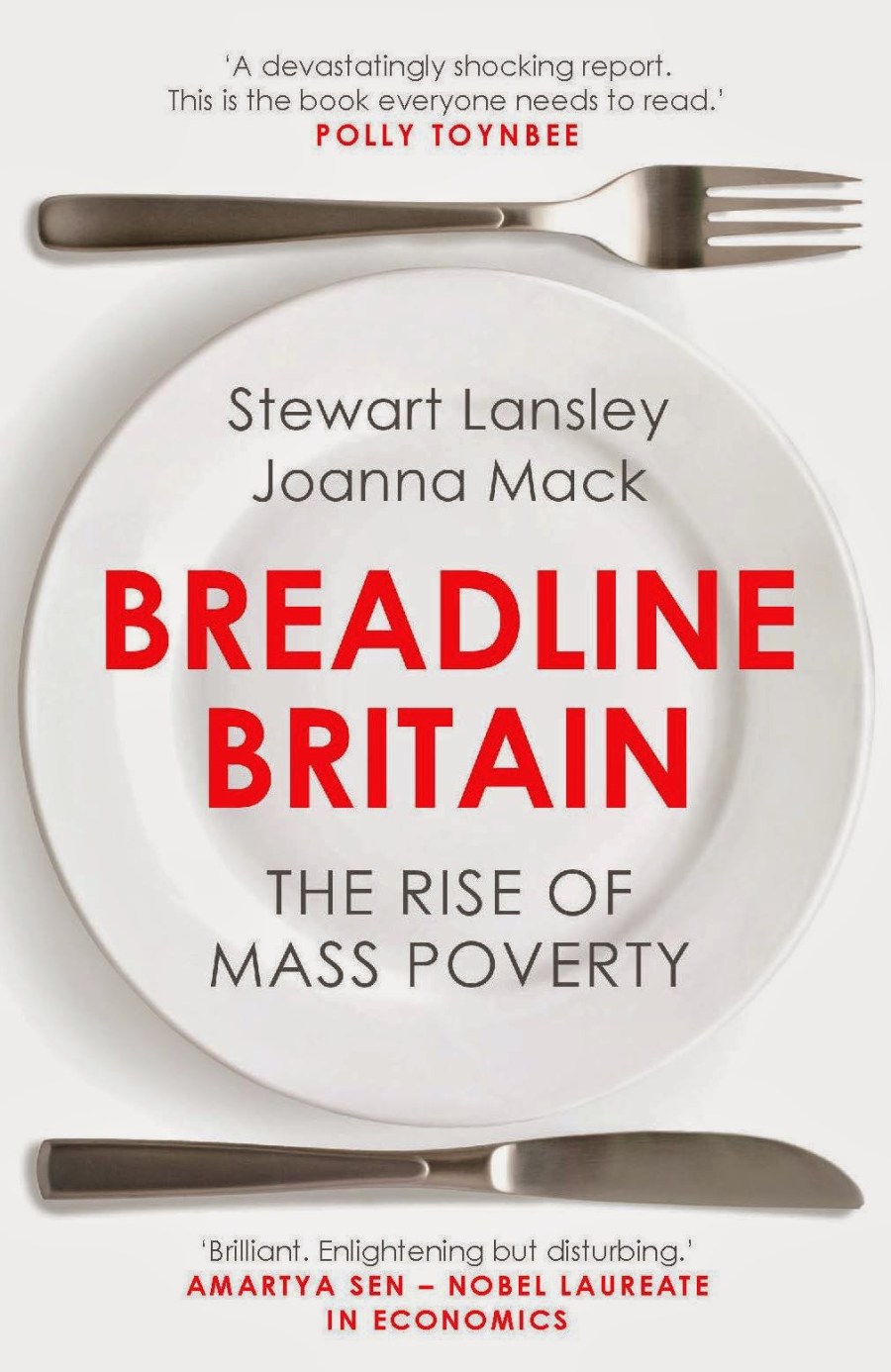
This review was for the book of the month section in February 2015 of UNITE Education.

This highly readable book is a devastating critique of how poverty levels that have increased right across the UK since the 1980s are the result of successive governments political choices that urgently need reversing.

Breadline Britain was the title for a 1983 TV series. By measuring the public’s perception of contemporary needs then for the first time public opinion was established as the central determinant of minimum living standards across the nation. This approach was refined in subsequent surveys in 1990, 1999 and two in 2012. The findings showed that the public accept that minimum living standards need to reflect present not past standards of living.

Needs are seen as extending beyond basics such as food and shelter. People are poverty-stricken when their income falls so far beyond that of their community that they cannot participate in it. As such, the percentage of households lacking three or more items or activities rated as necessities has doubled to 30 in 2012 from 14 in 1983. The latter was the year in which Prime Minister Margaret Thatcher told Norman Tebbit “we should neglect no opportunity to erode union membership,” as she fully understood that organised labour was the primary obstacle blocking her economic objectives that included allowing inequality to grow.

The likes of Thatcher contended that greater inequality had become a drag on economic dynamism and that poverty could not be eradicated by a narrower gap between rich and poor but by growth. What counts is the size of the cake not how it is distributed.

The worldwide experiments ever since of deregulated, unequal capitalism and greater inequality, boosted by massive tax cuts for the wealthy, have though miserably failed to bring, except for a modest number of people, the promise of a bigger cake.

In truth it never was going or intended to. The International Labour Organization has shown how nearly all large economies are ‘wage’ not ‘profit’ led and they experience slower growth when an excessive share of output is colonised by profits and how with less going to wages then purchasing power inevitably drops. The political solution adapted to this was to allow private debt to rocket, rising from 45 per cent of incomes in 1981 to a staggering 157 per cent in 2008. Meanwhile, the UK’s corporate cash piles stood at £166 billion in 2013, up a third in just five years. Internationally, wealth held offshore and hidden from the authorities is believed to be between $7.6 and $21 trillion. The rich are hoarding the money they’ve made from lower wages rather re-investing it in productive enterprises.

Poverty levels have thus leaped, especially amongst those at work. In 1983, one-third of those in poverty were in a household where the ‘head’ was working full or part time. Today it is 60 per cent. Bad jobs, zero hours contracts is currently further squeezing pay. Meanwhile, with the Tories dropping the human face they paraded when out of government, benefit levels have been cut and made even more restrictive. The New Policy Institute has identified that 63 per cent of families affected by the coalition’s cuts were already below the poverty level.

The result has been an increasing reliance by many people on borrowing from high interest loan companies and food banks, with the latter increasingly becoming a substitute for a uniform system of decent state support.

According to Lansley and Mack, a radical government programme is needed to prevent poverty rising further. With no advanced economy achieving a low rate of poverty without social investment in education, training and the provision of universal childcare then paying for all these will require boosting tax receipts by, amongst other initiatives, increasing the current 45% top rate of tax paid on annual earnings over £150,000.

Although the post-war welfare state was introduced on the assumption that there was a commitment to full employment and decent pay it has become the case that the benefits system has been used to step in to compensate for market failures to deliver decent livelihoods and housing opportunities. The growing housing benefit bill that has jumped from six to 22 billion £s in 20 years is the result of runaway house prices and a lack of affordable, socially provided housing.

Increasing the minimum wage and upping the numbers on the living wage should be part of policy objectives that include a commitment to full employment. Upping women’s pay in order to cut the 19 per cent pay gap between men and women is required.

Restoring the bargaining power in favour of the workforce back towards the 80 per cent covered by collective bargaining in 1979 rather than the current 25 per cent would be highly effective. Evidence consistently shows that the higher the level of trade union membership in a society the lower the degree of inequality. The erosion of trade union strength has also encouraged British employers to move down a low pay and productivity road with few incentives to improve workers skills, invest in research and development and introduce more productive processes.

With record corporate cash balances being held by large companies then a wage rise across many parts of the British economy is certainly feasible and it would have the effect of further boosting spending.

Many UNITE members reading this would undoubtedly agree with Lansley and Mack’s analysis and their objectives of slashing poverty as part of an economic package that will boost the economy as a whole. What the book lacks though is some understanding of how this might be achieved. They point to how the number of employers agreeing to pay the living wage has risen and how all the main political parties favour a modest hike in the national minimum wage. They illustrate how grass-roots pressure groups such as the Living Wage Campaign have launched high profile campaigns. They show how even the IMF head Christine Lagarde has warned that economic stability relies on a “more equal distribution of income.”

What is sadly ignored is the need to encourage all workers to become active trade unionists. No one pretends that this will be easy. But it is really only when workers are organised within their workplaces that they can achieve decent pay and conditions, not forgetting exerting greater power on politicians for radical economic and social changes.

These criticisms aside this book is very definitely worth reading. Lansley and Mack are to be congratulated in assembling in relatively few pages a wealth of information. It is to be hoped that their work helps encourage a debate on poverty at the forthcoming general election.
 

breadline britain - final 9781780745442

HOW CORRUPT IS BRITAIN?

HOW CORRUPT IS BRITAIN?

Edited by David Whyte, Professor of Socio-Legal Studies at the University of Liverpool.

Unite Education Book of the month for September 2015 

Pluto Press.


howcorruptisbritaincover

Bribery may not routinely happen in British police forces, public services or in government. But, as a wide range of campaigners demonstrate in this book there is endemic institutional corruption and that Parliament, regulatory bodies and the police are so implicated in this that they cannot hold others to account.

So successful has been the neoliberal project, which was started by Pinochet in Chile in the 70s and advanced by Thatcher and Reagan in the 80s, in establishing corporate control, even in liberal democracies, that when the banks collapsed because of their own dodgy, frequently illegal, practices in 2008 and Chancellor Alistair Darling stepped in with £500 billion of public funding he didn’t even reference Parliament. Instead he negotiated with a hand-picked group of elite bankers whilst eating a Balti takeaway.

Five years later David Cameron flew 131 business leaders to China on a government trade mission. The delegation included companies involved in bribery allegations connected to Chinese officials plus a broker fined for participating in the LIBOR rate-fixing scandal. Cameron defended the participating firms because he knew that if he vetted them for their unethical practices then the trade delegation would have be much smaller.

The ‘big four’ accountancy firms – Deloitte & Touche, PricewaterhouseCoopers (PwC), Ernst & Young and KPMG – assist many UK companies to avoid paying tax, including income tax on bonuses for an elite that includes corporate executives now earning 160 times the average UK worker’s pay. This is 20x the 18:1 ratio in 1980.

With its overseas territories and crown dependancies, Britain’s role as the world’s number 1 purveyor of financial secrecy ensures the City of London controls 25 per cent of the global market for offshore financial services. This helps conceal tax evasion and avoidance, estimated at £120 billion in 2012/13. David Cameron is himself the product of an offshore dynasty as his father chaired a  Jersey investment firm and co-founded a Panama registered investment company.

In the U.S, the big four, who, of course, gave the UK banks a clean bill of health when they audited them before the crash, have all been fined for corrupt practices. There has been no effective retribution here though. What may have helped the four was donating £3.5 million to the Tories before the 2010 General Election plus previous hefty donations to New Labour when it was in government.

There is also the ‘revolving door’, now common right across the state and corporate sector, whereby senior figures move from the private to public, and vice-versa, sectors. Former PwC staffer Mark Hoban thus became treasury minister responsible for oversight of tax laws between 2010-12. PwC partner Richard Abadie has been head of private finance policy at the Treasury.

The authors in this book, which includes essays on state torture, Hillsborough – including one from Sheila Coleman – and child sex abuse scandals, understand that many people realise how serious corruption is in Britain. What concerns the writers is that the public will regard corruption as unstoppable and something they can do nothing about. That each crime reported will lead to apathy, alienation and atomisation. It is up to all of us to ensure that is not the case.

Economics

The Greatest Invention: tax and the campaign for a just society 

The Greatest Invention: tax and the campaign for a just society

This book was the December 2015 book of the month for December at Unite education.

A Tax Justice Network (TJN) Production

£12.99 ISBN: 978-0-9931616-3-6

This is an excellent series of short, easy to read essays stretching back over a decade from the Tax Justice Network, the body which has done the most to change attitudes towards tax and the rich and powerful’s aim to avoid paying their proper share of it. If you need any persuading, or just want it reaffirmed, that the UK – and even the developing economies – can afford a decent standard of living, and properly resourced public services, for all their citizens then this book is a must read.

Multinational companies dominate the world economy with many firms having bases right across the globe. This has allowed them to avoid paying tax by employing transfer pricing whereby one part of the business that is based where tax levels are highest overpays for a product from another part of the business based in a country where tax levels are low or if it is a tax haven then non existent. These practices result in the latter being the most profitable sector of the business and ensures much less tax being paid than should be.

When the TJN investigated in 2002/3 they found that plastic buckets from the Czech Republic were costing $973 each, $585 more than the cost of bulldozers from Venezuela. And whilst many national tax authorities treat such tricks as tax evasion the sad fact of the matter is that many others don’t have the resources to properly scrutinise companies’ books to identify such transactions.

This drive to avoid tax by multinationals is part of a corporate culture that has seen them ruthlessly exploit many of the countries in which they are based. In Nigeria the oil companies have employed armies of accountants and auditors to effect tax evasion on their huge profits. To facilitate this process, and also secure major construction projects, the multinationals have subverted the political process by paying politicians and public officials to ‘look the other way.’

In countries where it’s not (regularly) possible to openly operate so corruptly that hasn’t prevented cheating by big business and the wealthy who, with most politicians, at best, too afraid to challenge their power, have developed a network of tax havens and tax avoidance and evasion schemes. The sums of money involved are incredible, trillions of £s remain untaxed, resulting in countries slashing the public services their citizens rely on.

The centre of much of these practices is the City (of London), with its network of investment bankers and the big four accountancy firms that all also operate a revolving door policy that takes politicians into lucrative posts and financiers into governments. Thankfully, the fantastic work of the TJN, which remains massively under resourced, means we now know much more about these problems and the book is packed with examples of the discoveries that this remarkable organisation has made and publicised.

To help tackle these abuses, morally repugnant actions and crimes, the TJN has worked with an impressive array of human rights activists, environmental groups, economists and politicians – including John McDonnell, Labour’s shadow chancellor – to formulate a series of ideas, political and practical objectives that can help chart the way ahead to a more efficient, socially productive and fairer society.

Widening the terms thus forms the latter part of the book. In the UK, amongst many other needs, it is time to rebalance the economy towards manufacturing and away from state subsidies on the likes of PFI projects that see taxpayers in the North and West overpay for projects that are built by companies largely based in London. Far better to have a publicly funded infrastructure development programme under which revenue streams accrue to the regions around the developments with the subsequent boost to the local economy.

Internationally there must be greater financial transparency, the abolition of shell companies, automatic exchange of tax information worldwide and a requirement of every multinational company to report their sales, profits and taxes paid in each country in which they operate. This would also prevent the activities of criminals such as terrorists, traffickers and money-launderers.

Finally, the book appendix includes the Tax Justice Network’s various declarations the first of which is dated in March 2003 and signed by nine people. There are no people who signed the latest one emanating from the April 2015 conference in Lima but that’s only because they’ve been replaced by over 100 organisations, some of significant standing. Such a huge increase in support is welcome but more is needed so please read the book, bring it to your fellow Unite members attention and consider supporting the TJN.

www.taxjustice.net

Salvador Allende, Revolutionary Democrat – author q@a

Monday, 14 October 2013

Salvador Allende, Revolutionary Democrat – author q@a

Salvador Allende, Revolutionary Democrat 
Pluto Press (£11.50) 
Author Q&A: Victor Figueroa Clark
This eloquent biography of socialist Salvador Allende offers an insight into the man – as a reformer and Marxist – who was president of Chile until he was ousted by General Pinochet in a US-backed coup in 1973. Figueroa Clark also provokes wider discussion on his legacy and global politics.
Why did you write this book?
I’d like Allende to be better known for his life and his Popular Unity (PU) government rather than for the manner of his death. I think his ideas may contain the seeds of how we can strive to achieve a transformation of our own society.
Was there anything in Allende’s formative years that made him a socialist?
Coming from a relatively privileged background, Allende saw the poverty of the mass of the population and was exposed to revolutionary ideas early on. He also had a family tradition of political radicalism and it was a time of revolutions worldwide. He became a medical student and an assistant in a psychiatric hospital, witnessing the brutal effects of inequality and exploitation.
Why did Allende favour the electoral road to socialism over guerilla warfare?
Allende believed Chile had the political structures and culture to enable an unarmed road to political power.
But he was not a pacifist and died defending his government with an AK in hand. His reforms were aimed at transforming society, the economy and the state away from dependent capitalism and towards socialism, not just providing material improvements to the poor.
What measures did Allende’s 1970-73 government introduce to improve the position of the poor and working classes?
The PU legally recognised the trade unions by bringing them into government and the management of nationalised industries. He provided half a litre of milk
to every child per day, vital in reducing malnutrition. A large-scale public housing programme was instituted and public services were extended to the vast shantytowns. His government nationalised the copper industry which continues to provide the bulk of Chile’s income.
Why did Allende commit suicide in 1973?
Allende confronted a violent, illegal military rebellion that was largely stoked and planned in the US. He fought out his last hours in an indefensible position understanding the powerful symbolism of defending the presidential palace and Chilean democracy.
What lessons might his life have for today?
The world remains plagued by poverty, injustice and exploitation. The richest countries still invade and subjugate the poorest. Inequality is growing. Allende said that since governments across the world had failed to deal with these issues, they must be caused by capitalism. Allende and his generation proposed to move away from capitalism. This is something I feel we ought to return to today if we want to overcome the immense challenges facing the world.

Who owns the world? Kevin Cahill Q & A (2007)

Monday, 25 November 2013

Who owns the world? Kevin Cahill q@a in 2007

WHO OWNS THE WORLD – THE HIDDEN FACTS BEHIND LAND OWNERSHIP 
Published in 2007 by Mainstream Publishing and written by Kevin Cahill.
Kevin Cahill is a former army officer who has worked at both Westminster and European parliaments as an adviser and researcher. This expanded upon 2001’s opus, Who Owns Britain, and is the first compilation of landowners and landownership structures in every single one of the world’s 197 states and 66 territories. This is a tome of huge political, economic and social importance.
How was the current pattern of land ownership across the world established?
By force and theft. If you look at the largest landowners now they are all monarchs, the descendants of despots and some of them still despots.
Who are some of the largest landowners in the world and how much land do they own?
The largest individual legal landowners on earth are: Queen Elizabeth II (6.6 billion acres); King Abdullah of Saudi Arabia (580 million acres); the Pope (about 177 million acres held in his name); King Bhumibol of Thailand (126 million acres); and King Mohamed V1 of Morocco (110 million acres, excluding the illegally occupied Western Sahara). The Queen owns one- sixth of the planet’s surface.
On what basis do you claim that the Queen is the sole owner of land in the UK?
I do not make a “claim” that the Queen is the sole owner of land in the UK. I merely repeat what the government states in the notes on the Parliamentary website relating to the Registration of Land Act 2002: “The Crown is the only absolute owner of land in England and Wales; all others hold an estate in land, in fee simple.” This is also the case in Australia, Canada and many other places. Freeholders do not own “their land” – fee simple is a medieval term for the sum paid to represent the fact that freehold was actually a tenancy.
Why do you describe the European Union in the book as an “outdoor relief organisation for Europe’s redundant aristocracy”?
Most of the agricultural land of Europe is still owned by European aristocracy and their cousins. Each year they get the bulk of the EU agricultural subsidy. For example, 77,000 landowners: 0.7 per cent of the farm landowners and 0.022 per cent of the European population own about 25 per cent of the farmland – about 112 million acres. They get $12,000 million in subsidy, a quarter of the subsidy.
How has so few people owning land in Europe affected the farmers in undeveloped nations?
There isn’t a direct connection but it works like this. If you are a poor farmer in Bangladesh, trying to grow, say, grain on five unsubsidised acres, you will find your- self trying to sell against someone who gets 113 Euros subsidy an acre in Europe. When issues of scale are thrown in, you have no hope.
Can you explain your claim that the current Chinese rulers are one of the most pragmatic regimes ever to rule one of the world’s great peoples?
The current regime knows that between 210BC and AD1900 Chinese peasant farmers revolted on 2,106 occasions to overthrow the regime on 48 occasions. The 49th in 1949 saw Chiang Kai-shek replaced with Mao when the peasantry lost their lands altogether under the new regime’s farm collectivisation. The current regime is moving to head off a peasant revolt by doling out land.
Now it is rare to find a ruling elite any- where in history which is so busily sowing the seeds of its own elimination but at the same time willing to put prosperity before both its own survival and the good of its people. Socialism as tried in China did not work. So now there is state communist- controlled market capitalism. But the end of that road is multiparty democracy and the rulers of China know this.
Why should people read this book?
To give them a better idea of where we came from, why we are where we are, and how we can get to a better place. This book tells the story of history in terms of the bulk of the world’s people, 97 per cent of whose ancestors never owned anything and 90 per cent of whom currently own nothing and are thus as poor as 97 per cent of humanity has been for the whole 10,000 years of recorded history.

Black Star – Britain’s Asian Youth Movements

Monday, 25 November 2013

BLACK STAR BRITAIN’S ASIAN YOUTH MOVEMENTS book review

BLACK STAR
BRITAIN’S ASIAN YOUTH MOVEMENTS
(Pluto Press, £17.50)
This is a vibrant, compelling history of the anti-racist campaigns of the British Asian youth movements (AYMs) of the 1970s and 1980s,
in which “black” identity was a political colour inspiring unity amongst all those struggling against racism.
Why did you write this book?
After 9/11, South Asians were framed within a traditional cultural-faith discourse. I wanted to represent a history which would present us as communities where politics was central to our identity. The AYMs were secular but the most important aspect was they were anti-racist and anti-imperialist and this understanding is crucial to young South Asians whatever their religious beliefs. AYMs also demonstrated when people stand together against injustice they will win and this is an important lesson for Muslims today faced with resisting anti-terror legislation.
What lay behind the slogan ‘black people must unite, here to stay, here to fight!”
It demonstrated these young south Asians were not trying to exclude themselves from society. But they wanted a Britain in which they were respected and treated equally and in which all individuals had the right to work on a living wage. The slogan highlighted unity amongst all black people which meant Africans and Asians, and even Chileans if they wished, because it was about a unity against racism.
Why did Asian youth find it necessary to organise independently?
Because racism was central to their experience, both as young people suffering street racial violence as well as discrimination by the state who framed them as “problems”. The left and trade unions meanwhile failed to address their own racism. Nevertheless, the youth were clear that the only real force in British society capable of fighting the growth of organised racism and fascism is the unity of the workers movement. They did not want to separate themselves from the left but to work with them as equals.
How did asserting “self-defence is no offence” help the Bradford 12 overcome charges of conspiracy to cause explosives and endanger lives following the police discovery of homemade Molotov cocktails in 1981?
The Bradford 12 was the first time the self-defence law had been used in the context of a community. Many of the key defendants had been involved in the anti-racist struggle. The cocktails were made because of genuine fears that racist skinheads were coming to Bradford to terrorise the Asian community and because the attitudes and previous history of the police in ignoring racist attacks showed they could not be depended upon to offer support. No cocktails were employed and defendants argued they had only produced them for self-defence, “should the need arise”. The case was won because there was a campaign and it was not simply a courtroom drama.
How important was state (local and national) funding in breaking up these once powerful grass roots organisations?
If you are struggling for a mother separated from her children and the law says all your appeal avenues are over then your independence means you can continue to pursue the case for justice as happened in the Anwar Ditta case. If you are struggling against police racism and corruption then you can name the police officers and their violence – as was done in the campaign to protect Gary Pemberton. It is also possible when appropriate to use direct action as a means of protest.  You can’t do this in state funded organisations.

The Assassin’s Mark – David Ebsworth

Thursday, 24 October 2013

Book review – the Assassin’s Mark

The Assassin’s Mark – David Ebsworth

£9.99 SilverWood Books

Dave Ebsworth – who in real-life is former TGWU regional secretary Dave McCall – has written a highly enjoyable and very descriptive novel set in the final year of the 1936-1939 Spanish Civil War. With the elected Republican government in disarray a confident General Franco has opened up the bloody battlefields along the country’s north coast to invite tourist’s to celebrate his successes and turn a blind eye to the atrocities he – and his Italian and German Allies – has committed.

Peace-loving, naïve left-wing reporter, Jack Telford, is asked by his employer to spend two weeks travelling by bus with a group of visitors that on the surface he has politically little in common with. It’s a journey of great heartbreak but also great beauty and Ebsworth brings both skilfully alive. The author provides vivid descriptions, especially of the architecture and social atmosphere, which helps transport the reader back 75 years.

Finding himself drawn to a right-wing female journalist, Telford can’t help but grow fond of many of his fellow tourists. Especially when the group is captured by Republican guerrillas and rescued by Franco’s forces in the days before a planned meeting with the general when Telford faces being betrayed.

David Ebsworth is the author of The Jacobites’ Apprentice, which was critically reviewed by the Historical Novel Society, who deemed it “worthy of a place on every historical fiction bookshelf”. For more information on Dave’s work visit www.davidebsworth.com

The State in Capitalist Society by Ralph Miliband

Wednesday, 18 December 2013

Book review – The State in Capitalist Society by Ralph Miliband

The Daily Mail last year criticised Ralph Miliband, the father of Labour leader Ed, calling him, because of his Marxist beliefs, “the man who hated Britain.”
The Belgium-born Polish Jew fled with his father to Britain in 1940 after Nazi Germany invaded Belgium. He served in the Royal Navy during the Second World War and gained British citizenship in 1948. He became involved in left-wing politics and made a personal commitment to socialism at the grave of Karl Marx.
Miliband published a number of books during his lifetime. His first in 1961, Parliamentary Socialism, found the Labour Party lacking radicalism and obsessed with retaining the confidence of business and financial interests. This led to an intolerance towards extra-parliamentary actions and failing to offer an alternative to capitalism.
In 1969, Miliband’s The State in Capitalist Society was published. It is generally considered his finest piece of work. It is based on how we all live in the shadow of the state and increasingly  depend on its sanction and support.
Miliband’s book challenged the prevailing political orthodoxy that power in Western societies was competitive, fragmented and diffused. As such the state – consisting of the government, the administration, the military and the police, the judiciary, sub-central government (such as regional assemblies) and parliamentary assemblies – could not fail to respond to the demands of competing interests during the decision making process. The notion of a ‘ruling class elite’ was seen as absurd. Consequently capitalism had been radically – and democratically – transformed since its inception during the industrial revolution.
Miliband demonstrated the reverse, highlighting how the increasing concentration of private economic power had already transformed all states into instruments of the giant corporation’s bidding, bringing in its wake massive and growing inequalities. A tiny number of children from working class backgrounds may make it to the very top of society, but the overall structure remains intact as this does not pose a serious challenge to capitalism.
The state, argued Miliband, is partisan when industrial disputes occur and governments – of all political persuasions – will seek to place inhibitions upon organised labour and leave wage-earners in a weaker position compared to employers. ‘Democracy’ also requires ensuring left-wing dissent plays as weak a role as possible. Trade unions are only ‘good’ when they don’t raise excessive wage claims or seek to radically alter society on behalf of working people. Miliband feared that even in advanced capitalist societies such demands would increasingly be met by conservative authoritarianism and the state surveillance and harassment that accompanies it.
Miliband was frustrated because he recognised that productive and technological advances had revealed a material capacity for human liberation but ‘advanced capitalist societies cannot achieve this within the confines of an economic system which remains primarily geared to the private purposes of those who own and control its materials resources……
He sought instead ‘societies with a spirit of sociality and cooperation from their members, a sense of genuine involvement and participation’ and in which ‘the state will be converted from an organ superimposed upon society into one completely subordinated to it.’
Written 44 years ago, the State in Capitalist Society, remains, in the wake of the current neoliberal austerity project, valuable reading today.