HILLSBOROUGH VOICES: THE REAL STORY TOLD BY THE PEOPLE THEMSELVES

HILLSBOROUGH VOICES: THE REAL STORY TOLD BY THE PEOPLE THEMSELVES was the book of the month at the Unite Education department in September 2016. 

http://www.unitetheunion.org/growing-our-union/education/bookofthemonth/september-2016/

The book is written by Liverpool fan Kevin Sampson and is in association with the HILLSBOROUGH JUSTICE CAMPAIGN in which Sheila Coleman, the Unite Community co-ordinator in the North West, has played a crucial role. 

The book is a tearjerker. How can it not be, detailing as it does the tragedy of Hillsborough when 96 football fans lost their lives on 15 April 1989 and 766 more were injured? Grieving relatives, traumatised survivors and fans who’d witnessed the tragedy were then dealt a further grievous blow when, with press support, the police in charge of events sought to deflect attention away from their own catastrophic failures by blaming those fans who were fortunate enough to survive that fateful day.

At the same time this book, published just before the unlawful killing verdicts in the new inquests, is a truly inspiring authentic account of a heroic ongoing struggle by decent, honourable people for truth and justice. 

With membership of the Hillsborough Families Support Group restricted to families only, the HJC was set up in 1998 by bereaved families and survivors with the aim of pro-actively campaigning for justice for those affected by the tragedy.

Author Kevin Sampson witnessed the horror firsthand. Kevin spent 18 months conducting extensive and exclusive interviews with survivors, families and friends who’d lost loved ones and public figures.

The book as Andy Burnham MP, an Everton fan who played a crucial role in the fight for justice, states, in the foreword, is thus a voice for “the real Hillsborough voices.”  

This is sample of some of those voices in this powerful, well written and must read book. Want to know about Hillsborough? Read this book. 

“Everyone knew the Leppings Lane was a bad end.” Peter Hooton.

“I heard this police officer and stewards saying they were going to open a gate. I saw them do so. People entered at a steady walking pace. Yet the police’s official line was that a ‘tanked-up mob’ had stormed the gates.” Steve Hart

“Most people headed down the tunnel to the middle section.” Jegsy Dodd

“Hello! magazine centre-page was of the central pens at the moment where nearly a hundred people are about to lose their lives.” Martin Thompson.

“The police officer pulled out this Polaroid and threw it on the table…. I picked it up. It was Mike. Dead.” Steve Kelly

“In September 1990 the DPP ruled there would be no criminal proceedings.”  Barry Devonside.

“HJC accepted membership from anyone who wanted support and we embraced the survivors…without whom..…there would have been no way of reclaiming the truth.” Steve Kelly.

“JUSTICE FOR THE 96” The Kop for the first six minutes of the Liverpool v Arsenal FA Cup tie in 2007.

“Andy Burnham was very brave saying what he did.” Jegsy Dodd.

“Home Secretary Alan Johnson announced the formation of the Hillsborough Independent Panel in December 2009.” Steve Rotheram

“When Bishop James Jones, the panel chair, said words to the effect of, “Liverpool supporters have been exonerated from any blame for the deaths of the 96 people,” three people nearby fainted.” Barry Devonside

“The new evidence demonstrates these families have suffered a double injustice – the failure of the state to protect their loved ones and the indefensible wait for the truth. And the injustice of the denigration of the deceased – that they were somehow responsible for their own deeds.”

David Cameron 12 September 2012.

“In December 2012 the judge quashed the original accidental death verdicts on the basis of evidence we’d presented in November 1993.” Sheila Coleman

“Looking back it could have happened at any match.” Danny Rhodes.

“We should distinguish between justice and the law…I don’t think justice will be truly achieved…..we are governed by some who would have difficulty spelling justice, let alone  placing any value upon it.” Sheila Coleman.

HALIFAX 1842: A Year of Crisis

Listen to Mark recounting the events of 1842

HALIFAX 1842: A Year of Crisis by Catherine Howe (Breviary Stuff Publications)

Halifax1842

Catherine Howe has done an incredible job by discovering a significant piece of West Yorkshire history that very few people know anything about.

The period from 1838 to 1848 was made famous by Chartism. This was the first working-class movement in Britain. It sought to end exploitation by ensuring working class representation in Parliament, dominated at the time by the landed aristocracy, and had six demands: universal (male) suffrage, equal electoral districts, secret ballots, annual Parliaments, payment for MPs and no property qualifications for MPs. With just 8 per cent of the adult male population possessing the vote these were radical demands.

1837 had heralded in the New Poor Law, which ended direct financial help to the poor, who from thereon would only receive help by undertaking monotonous backbreaking labour inside the workhouse. On 16 May 1837 a massive 100,000-strong gathering was held on Hartshead Moor. Other  similar gatherings but when they produced no change in government policies the People’s Charter petition was drawn on 8 May 1838.

Over 1.3 million, including 13,000 from Halifax, signed yet on 14 June 1839 it was rejected in Parliament by 235 votes to 46.

In autumn 1839, South Wales miners and ironworkers revolted and twenty died when they were shot down by armed soldiers armed waiting in Newport. Further disturbances in Sheffield, Dewsbury and Bradford followed whilst some Chartist leaders were convicted of seditious libel and imprisoned. Meanwhile, whilst newly industrialised workers, including many children, continued to be killed in factories, mills and mines, Parliament remained indifferent to their fate.

On 2 May 1842, another giant three million strong petition was handed to Parliament and again swiftly rejected by 287 to 49 votes. In early August 1842 miners walked-out in the Black Country, which led to lay-offs in the neighbouring Potteries. Within days, workers in Lancashire were being laid-off and spotting an opportunity to direct the situation to their advantage the Chartists incited more walk-outs. There were fatal consequences when workers and the military clashed at Preston and Blackburn

A meeting of the leaders of Britain’s trades was held in Manchester where ignoring the presence of troops it was agreed to tramp over the Pennines and into Yorkshire. Halifax was being drawn into the conflict.

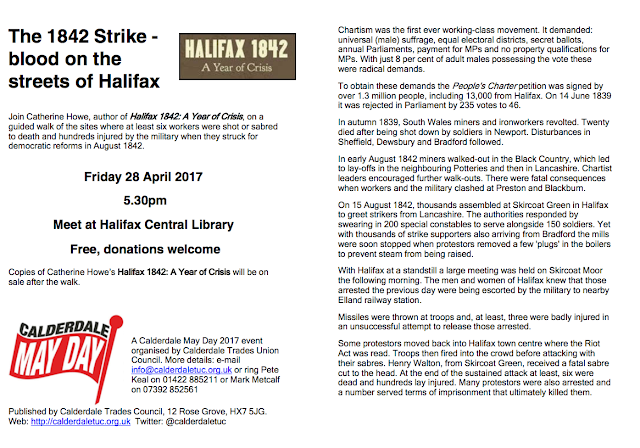
On 15 August 1842, thousands were at Skircoat Green just outside Halifax to greet the Lancashire marchers. The authorities had decided to meet force with force and had sworn in 200 special constables to serve alongside 150 soldiers. Yet with thousands arriving from across Yorkshire this was never going to be sufficient to prevent the mills of Halifax from being stopped from working by the protestors, who entered and removed a few bolts or ‘plugs’ in the boilers so as to prevent steam from being raised.

Halifax was at a standstill and a large meeting was held on Skircoat Moor around a mile from the town centre the following morning.

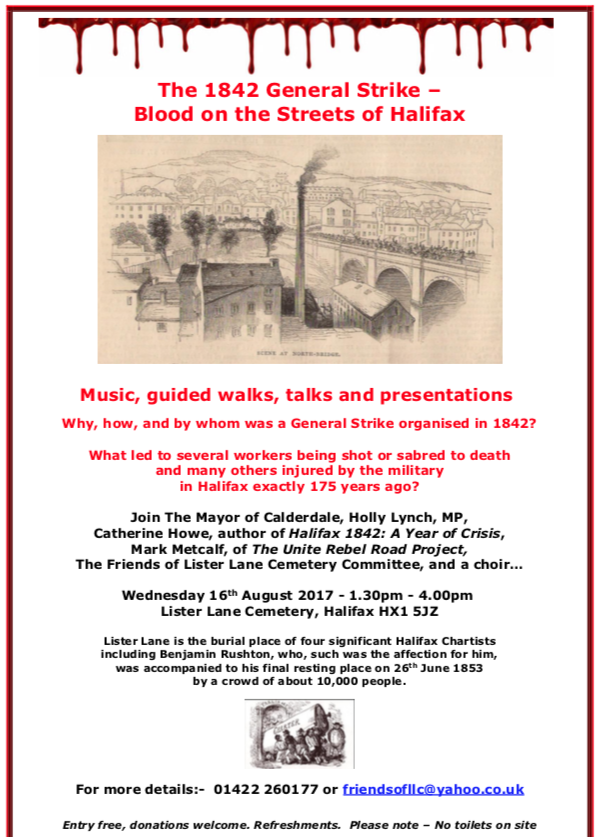
When Skircoat Green was passed by the departing crowd they became aware that those arrested the previous day would be escorted by the military to nearby Elland railway station and they made to release their friends. Missiles were thrown at troops and, at least, three were badly injured in an ultimately unsuccessful attempt to release those arrested. Following the stoning a number of the crowd moved back to the Moor and then later into Halifax town centre where the riot act was read and troops, still smarting from the humiliation that morning, fired into the crowd before attacking it with their sabres. Henry Walton, from Skircoat Green, received a fatal sabre head cut. By the time the military had done their worst hundreds had been injured and, at least, six were dead. Many protestors were also arrested and a number served terms of imprisonment that ultimately killed them.

Such was the determination of those then in power to prevent working class people obtaining the vote and with it political representation. Six years later another giant Charter petition to Parliament was again rejected and it was not till 1867 when an alliance between the middle and working class brought about an Act that doubled the male electorate and thereafter the path was paved towards universal suffrage for men and women.

guidedwalk
39 people attended 

Lister Lane commemoration of 1842
100 people attended this event. 

AGRICULTURE – A Very Short Introduction by Paul Brassley & Richard Soffe

Tuesday, 3 January 2017

Book review: AGRICULTURE – A Very Short Introduction by Paul Brassley & Richard Soffe

AGRICULTURE AND ALL THAT
AGRICULTURE – A Very Short Introduction by Paul Brassley & Richard Soffe
When YouGov-Cambridge conducted a poll in 2012 they found that 82 per cent of people have a special place in their hearts for agriculture. However the poll also revealed that only 28 per cent of people feel they know much about the sector. So congratulations to the Oxford University Press for supplying a book that explains it all.
The authors are experts Paul Brassley, who has taught agricultural economics for over thirty years, and Richard Soffe, director of the Rural Business School at Duchy College. Unite’s Charlie Clutterbuck helped on the manuscript.
Charlie Clutterbuck is a soil scientist and the book starts by examining soil which is ‘a complex mixture of air, water, minerals, and organic matter that has evolved, in many cases, over thousands of years.’ What matters for a farmer is the texture and structure of the soil, which physically supports growing plants and supplies water to their roots.
Humans live on plants and the first chapter looks at how plants grow, what stops them doing so, how growth can be improved and also examines major crops and cultivation systems employed by farmers seeking to increase productivity.
This is, of course, a life or death subject because when things go wrong, like they did in mid nineteenth century in Ireland with the potato blight that was caused by a fungus, it has a disastrous consequences for millions.
Chapter 2 looks at the small number of animals that humans have domesticated and examines what farmers need to know about feeding, breeding disease control and production systems in order to make them grow quickly. Whereas breeders historically worked by eye and memory, today animal breeding can be a highly scientific process that has revolutionised livestock production by bringing about genetic change.
In the past farmers struggled to produce sufficient food for their families. In some parts of the world that remains true today but in most countries, farmers spend much of their time selling their excess supply and chapter 3 considers how the markets, local and international, operate so the food we need to live on makes its way into the shops and restaurants at a price we can afford to pay.
Chapters 4 and 5 examine inputs into agriculture. Left to itself land will produce only enough food for a tiny number of people. Modern and traditional farming, the latter summed up by John Clare in his poem The Mores: ‘Inclosure came and trampled on the grave – Of Labour’s right and left the poor a grave’.
The final chapter on farming futures examines the most important questions that agricultural policy makers are currently grappling with including genetically modified organisms.
The population of the world is calculated to reach 9.3 billion by 2050 and thus the race is on to raise productivity across the globe.
Published by Oxford University Press,
£7.99
152 pages

AGRICULTURE – A Very Short Introduction by Paul Brassley & Richard Soffe

Tuesday, 3 January 2017

Book review: AGRICULTURE – A Very Short Introduction by Paul Brassley & Richard Soffe

AGRICULTURE AND ALL THAT
AGRICULTURE – A Very Short Introduction by Paul Brassley & Richard Soffe
When YouGov-Cambridge conducted a poll in 2012 they found that 82 per cent of people have a special place in their hearts for agriculture. However the poll also revealed that only 28 per cent of people feel they know much about the sector. So congratulations to the Oxford University Press for supplying a book that explains it all.
The authors are experts Paul Brassley, who has taught agricultural economics for over thirty years, and Richard Soffe, director of the Rural Business School at Duchy College. Unite’s Charlie Clutterbuck helped on the manuscript.
Charlie Clutterbuck is a soil scientist and the book starts by examining soil which is ‘a complex mixture of air, water, minerals, and organic matter that has evolved, in many cases, over thousands of years.’ What matters for a farmer is the texture and structure of the soil, which physically supports growing plants and supplies water to their roots.
Humans live on plants and the first chapter looks at how plants grow, what stops them doing so, how growth can be improved and also examines major crops and cultivation systems employed by farmers seeking to increase productivity.
This is, of course, a life or death subject because when things go wrong, like they did in mid nineteenth century in Ireland with the potato blight that was caused by a fungus, it has a disastrous consequences for millions.
Chapter 2 looks at the small number of animals that humans have domesticated and examines what farmers need to know about feeding, breeding disease control and production systems in order to make them grow quickly. Whereas breeders historically worked by eye and memory, today animal breeding can be a highly scientific process that has revolutionised livestock production by bringing about genetic change.
In the past farmers struggled to produce sufficient food for their families. In some parts of the world that remains true today but in most countries, farmers spend much of their time selling their excess supply and chapter 3 considers how the markets, local and international, operate so the food we need to live on makes its way into the shops and restaurants at a price we can afford to pay.
Chapters 4 and 5 examine inputs into agriculture. Left to itself land will produce only enough food for a tiny number of people. Modern and traditional farming, the latter summed up by John Clare in his poem The Mores: ‘Inclosure came and trampled on the grave – Of Labour’s right and left the poor a grave’.
The final chapter on farming futures examines the most important questions that agricultural policy makers are currently grappling with including genetically modified organisms.
The population of the world is calculated to reach 9.3 billion by 2050 and thus the race is on to raise productivity across the globe.
Published by Oxford University Press,
£7.99
152 pages

The Village in REVOLT – the story of the longest strike in history by Shaun Jeffrey 

Friday, 21 September 2018


The Village in REVOLT – the story of the longest strike in history by Shaun Jeffrey

https://www.waterstones.com/book/the-village-in-revolt/shaun-jeffery/9781527222250

Article from uniteLANDWORKER Summer 2018

Unite activist Shaun Jeffrey has written a definitive account of Annie and Tom Higdon, the teachers who inspired the 1914 to 1939 Burston School Strike – the longest in history.

How the Higdons ended up in the small South Norfolk village of Burston is a fascinating story charting the economic, political and social changes that changed Britain in the second half of the nineteenth century and into the twentieth.

Tom Higdon was born in 1869 in an agricultural dwelling in Huxham, Somerset. There is no indication that his dad, Dennis, who was to be still working in 1911 at aged 78 as a farm labourer, was a trade unionist. This after all was an era when indicating that you were interested in combining with your fellow workers would lead to victimisation by farmers.

In 1872 Francis George Heath’s investigative account, The “Romance” of Peasant Life in the West of England, recorded the hardship experienced by Somerset agricultural labourers and their families.

Attempts at establishing an agricultural workers union in 1868 had failed but in 1872 a mass strike wave, started in Warwickshire, led to the founding of Joseph Arch’s National Agricultural Labourers’ Union. (N.A.L.U)

Annie Schollick, born 1864, was from Cheshire. Her grandfather and father, Samuel, were carpenters.

Her uncle Edward entered domestic service.  When his employer, the Reverend Dr John Stonard, who had no immediate family, died Edward was made the benefactor of his estate. Edward shared his fortune with his family including Samuel, who became a small ship builder and also paid for private tuition for his daughter. Annie  became an unqualified governess before undertaking formal training as an elementary teacher in a Sussex Church of England school.

The 1870 Education Act, introduced in an attempt to keep Britain internationally competitive at a time of rapid industrialisation, enshrined universal education in law. Tom Higdon thus received what the Education Act intended; a school place, in a new building, with a certified head teacher. At harvest time, Tom joined other children in helping gather in the crops, alongside their parents. Tom later became a farm labourer like his dad.

In 1892, Annie Schollick successfully applied for the post of headmistress at East Lydford, just four miles from Huxham. It was a tough post but, at least, she was back in a rural setting. Four years later Annie married Tom, who signed the marriage certificate stating he was a teacher. It is not known how the pair met and why, how and where Tom did his pupil-teacher training.

In 1899, Tom became assistant master to his wife, headmistress at St James’s and St Peter’s School, a Church of England school in the poor quarter of Soho. Their combined passion for education and social justice had become a missionary pursuit for them.

In 1902 the couple returned to a rural setting, this time at Wood Dalling in Norfolk. They found that the schoolhouse urgently needed repairing as very little money had been spent on it in the previous decade. They soon discovered that local farmers would remove pupils from school to work for them. When the Higdons raised these issues with the School Board it caused problems with the authorities and farmers – who practised their own form of class solidarity by always sticking together to keep down wages and conditions and who also did not take kindly to demands to close the school when illnesses such as whooping cough became epidemic.

But the new teachers became popular with the children and parents who appreciated their hard work, their generosity in spending their own money on boots and clothing for any pupils whose parents could not afford them and the general desire to improve the education and outlook of those under their charge.

Meanwhile, no one, friend or foe, suggested the Higdons were poor teachers.

In early 1906 the labourers across Norfolk were to assert their own increased spirit of independence. Led by George Edwards they formed the Eastern Counties Agricultural Labourers’ and Small Holders’ Union. Early in 1907 a meeting was held in Wood Dalling and after the new branch was formed Tom Higdon became branch secretary. He then set off by bicycle to establish other branches across South Norfolk.

As tension increased between the Higdons and the school mangers the Norfolk Education Committee carried out in 1908 an inquiry, the results of which were inconclusive. The following year there were further arguments when Annie and Tom sought to close the school after a diphtheria outbreak.

Tom’s union work continued and in March 1910 he organised local labourers to win seats on the Parish Council at the expense of local farmers. This direct political challenge was never going to remain unanswered. There soon appeared a series of spurious charges by the school managers against the teachers who after a second inquiry were dismissed.

Local people were indignant. All but three parents petitioned the Education Committee to reinstate them. The two school managers nominated by the parish council protested strongly and wrote to the Committee resigning their positions. Protest letters were sent from the parish council and from the local branch of the Agricultural Labourers’ Union.

Whilst these efforts failed to get the Higdons reinstated it did lead to the Education Committee agreeing to offer them new posts. On December 31, 1911 the couple entered the small village of Burston to start work at the local school the following morning. Having failed to properly represent them at the inquiry, the Higdons refused to entertain the National Union of Teachers offer to pay for the transfer of their goods Burston.

The Higdons found that the school was in a dire strait. The newly arrived rector, whose early life is well covered by Jeffrey, the Reverend Charles Tucker Elland, was an arrogant man whose appointment as chairman of the school management board meant conflict was certain. Tucker demanded deference of his right to lead the community.

In a desire to restore old footpaths, repair bridges and make improvements to housing, Tom and other agricultural labourers stood against and beat Elland and local farmers at the 1913 parish council election.

But Elland and his supporters remained in control of the school management board. Annie was falsely accused of many things including lighting without permission a fire – used to children’s wet clothes  – and beating two Barnardo girls, despite her well-established pacifist principles. These two charges were disproved at the inquiry that was held by the Norfolk Education Authority but the Higdons were given three months’ notice after an accusation of discourtesy to the managers was accepted.

If the rector and his supporters were delighted with the outcome the school pupils and their parents were not content to let the Higdons down.

On 1 April, 1914, 66 of the 72 pupils had gone on strike. Lessons restarted on the village green.

An old workshop was found, no matter what the weather lessons could continue. Attempts to intimidate parents into sending their children to the official school flopped as their court fines were being paid by donations and they had a legal right to send their children to a school of their choice.

Once WWI began local farmers could not, thanks to a labour shortage, afford to dismiss farm labourers who sent their children to the new school, which few disputed was a good one.

As news spread of the strike the labour movement – particularly the National Union of Railwaymen, the Miners’ and the National Union of Agricultural Workers (NUAW) rallied to support the new school. Donations made it possible to pay the Higdons and build a new school with facilities better than the old one.

Officially opened on May 13, 1917 by Violet Potter, organiser of the original demonstration on April Fool’s Day 1914, the school lasted till 1939 when Tom died and Annie, who died in 1946, was too old to continue on her own. They are buried alongside each other in Burston churchyard.

The NUAW established the Strike School as a registered educational charity in 1949. In the early 80s when the NUAW merged with the TGWU the school became a museum. An annual rally was initiated in 1984 and in recent years this has attracted large crowds of over 3,000 people on the first Sunday in September.

Shaun Jeffrey is the secretary of the Burston Strike School and a member of the Great Yarmouth and District branch of Unite.

The Village in REVOLT – the story of the longest strike in history by Shaun Jeffrey 

Friday, 21 September 2018

The Village in REVOLT – the story of the longest strike in history by Shaun Jeffrey

https://www.waterstones.com/book/the-village-in-revolt/shaun-jeffery/9781527222250

Article from uniteLANDWORKER Summer 2018

Unite activist Shaun Jeffrey has written a definitive account of Annie and Tom Higdon, the teachers who inspired the 1914 to 1939 Burston School Strike – the longest in history.

How the Higdons ended up in the small South Norfolk village of Burston is a fascinating story charting the economic, political and social changes that changed Britain in the second half of the nineteenth century and into the twentieth.

Tom Higdon was born in 1869 in an agricultural dwelling in Huxham, Somerset. There is no indication that his dad, Dennis, who was to be still working in 1911 at aged 78 as a farm labourer, was a trade unionist. This after all was an era when indicating that you were interested in combining with your fellow workers would lead to victimisation by farmers.

In 1872 Francis George Heath’s investigative account, The “Romance” of Peasant Life in the West of England, recorded the hardship experienced by Somerset agricultural labourers and their families.

Attempts at establishing an agricultural workers union in 1868 had failed but in 1872 a mass strike wave, started in Warwickshire, led to the founding of Joseph Arch’s National Agricultural Labourers’ Union. (N.A.L.U)

Annie Schollick, born 1864, was from Cheshire. Her grandfather and father, Samuel, were carpenters.

Her uncle Edward entered domestic service.  When his employer, the Reverend Dr John Stonard, who had no immediate family, died Edward was made the benefactor of his estate. Edward shared his fortune with his family including Samuel, who became a small ship builder and also paid for private tuition for his daughter. Annie  became an unqualified governess before undertaking formal training as an elementary teacher in a Sussex Church of England school.

The 1870 Education Act, introduced in an attempt to keep Britain internationally competitive at a time of rapid industrialisation, enshrined universal education in law. Tom Higdon thus received what the Education Act intended; a school place, in a new building, with a certified head teacher. At harvest time, Tom joined other children in helping gather in the crops, alongside their parents. Tom later became a farm labourer like his dad.

In 1892, Annie Schollick successfully applied for the post of headmistress at East Lydford, just four miles from Huxham. It was a tough post but, at least, she was back in a rural setting. Four years later Annie married Tom, who signed the marriage certificate stating he was a teacher. It is not known how the pair met and why, how and where Tom did his pupil-teacher training.

In 1899, Tom became assistant master to his wife, headmistress at St James’s and St Peter’s School, a Church of England school in the poor quarter of Soho. Their combined passion for education and social justice had become a missionary pursuit for them.

In 1902 the couple returned to a rural setting, this time at Wood Dalling in Norfolk. They found that the schoolhouse urgently needed repairing as very little money had been spent on it in the previous decade. They soon discovered that local farmers would remove pupils from school to work for them. When the Higdons raised these issues with the School Board it caused problems with the authorities and farmers – who practised their own form of class solidarity by always sticking together to keep down wages and conditions and who also did not take kindly to demands to close the school when illnesses such as whooping cough became epidemic.

But the new teachers became popular with the children and parents who appreciated their hard work, their generosity in spending their own money on boots and clothing for any pupils whose parents could not afford them and the general desire to improve the education and outlook of those under their charge.

Meanwhile, no one, friend or foe, suggested the Higdons were poor teachers.

In early 1906 the labourers across Norfolk were to assert their own increased spirit of independence. Led by George Edwards they formed the Eastern Counties Agricultural Labourers’ and Small Holders’ Union. Early in 1907 a meeting was held in Wood Dalling and after the new branch was formed Tom Higdon became branch secretary. He then set off by bicycle to establish other branches across South Norfolk.

As tension increased between the Higdons and the school mangers the Norfolk Education Committee carried out in 1908 an inquiry, the results of which were inconclusive. The following year there were further arguments when Annie and Tom sought to close the school after a diphtheria outbreak.

Tom’s union work continued and in March 1910 he organised local labourers to win seats on the Parish Council at the expense of local farmers. This direct political challenge was never going to remain unanswered. There soon appeared a series of spurious charges by the school managers against the teachers who after a second inquiry were dismissed.

Local people were indignant. All but three parents petitioned the Education Committee to reinstate them. The two school managers nominated by the parish council protested strongly and wrote to the Committee resigning their positions. Protest letters were sent from the parish council and from the local branch of the Agricultural Labourers’ Union.

Whilst these efforts failed to get the Higdons reinstated it did lead to the Education Committee agreeing to offer them new posts. On December 31, 1911 the couple entered the small village of Burston to start work at the local school the following morning. Having failed to properly represent them at the inquiry, the Higdons refused to entertain the National Union of Teachers offer to pay for the transfer of their goods Burston.

The Higdons found that the school was in a dire strait. The newly arrived rector, whose early life is well covered by Jeffrey, the Reverend Charles Tucker Elland, was an arrogant man whose appointment as chairman of the school management board meant conflict was certain. Tucker demanded deference of his right to lead the community.

In a desire to restore old footpaths, repair bridges and make improvements to housing, Tom and other agricultural labourers stood against and beat Elland and local farmers at the 1913 parish council election.

But Elland and his supporters remained in control of the school management board. Annie was falsely accused of many things including lighting without permission a fire – used to children’s wet clothes  – and beating two Barnardo girls, despite her well-established pacifist principles. These two charges were disproved at the inquiry that was held by the Norfolk Education Authority but the Higdons were given three months’ notice after an accusation of discourtesy to the managers was accepted.

If the rector and his supporters were delighted with the outcome the school pupils and their parents were not content to let the Higdons down.

On 1 April, 1914, 66 of the 72 pupils had gone on strike. Lessons restarted on the village green.

An old workshop was found, no matter what the weather lessons could continue. Attempts to intimidate parents into sending their children to the official school flopped as their court fines were being paid by donations and they had a legal right to send their children to a school of their choice.

Once WWI began local farmers could not, thanks to a labour shortage, afford to dismiss farm labourers who sent their children to the new school, which few disputed was a good one.

As news spread of the strike the labour movement – particularly the National Union of Railwaymen, the Miners’ and the National Union of Agricultural Workers (NUAW) rallied to support the new school. Donations made it possible to pay the Higdons and build a new school with facilities better than the old one.

Officially opened on May 13, 1917 by Violet Potter, organiser of the original demonstration on April Fool’s Day 1914, the school lasted till 1939 when Tom died and Annie, who died in 1946, was too old to continue on her own. They are buried alongside each other in Burston churchyard.

The NUAW established the Strike School as a registered educational charity in 1949. In the early 80s when the NUAW merged with the TGWU the school became a museum. An annual rally was initiated in 1984 and in recent years this has attracted large crowds of over 3,000 people on the first Sunday in September.

Shaun Jeffrey is the secretary of the Burston Strike School and a member of the Great Yarmouth and District branch of Unite.