Thomas Spence “Dare to be free”


Thomas Spence plaque11-14403

The life of land reformer and political activist Thomas Spence is  commemorated in his home city of Newcastle with a plaque on the Quayside where he was born, in 1750, and later ran a school. Its mounting in 2010 ended a 10-year campaign by the trust established in Spence’s name. One of net maker Jeremiah Spence’s nineteen children, Thomas Spence entered the world in turbulent times with land clearances and industrialisation pushing people off the land and into the factories.

After initially working alongside his father, Spence became a teacher. Disturbed by the poverty he saw all around him it wasn’t long before he began to agitate for improvements. At aged 15 he published and sold his pamphlet, The Real Rights of Man. This was inspired by a lawsuit between the freemen (a person who enjoys political and civil liberties)  and Newcastle Corporation over the use of common land. It was to be the first of many pamphlets Spence was to be involved with until his death in 1814.

He agitated for all land to be held in common ownership by each parish. People were to be given their own plots on which to grow the necessities of life with profits from the rents to be employed to support local services such as libraries and schools. Having secured the vast majority of land for themselves in 1066 and during Henry the VIII’s reign with the dissolution of the monasteries, then the large landowners were not going to allow Spence’s idea’s to gain the converts he needed to turn theory into practice. By 1794 he was facing high treason charges in court. There he took up Thomas Paine’s arguments against hereditary aristocracy by following it to a natural conclusion in arguing for the end of private property in land. He was given seven months at his majesty’s pleasure, but imprisonment failed to curb a man whose favourite slogan was “dare to be free”.

Further spells in prison followed as Prime Minister William Pitt the Younger sought to eradicate radical ideas in Britain by suspending Habeas Corpus on many occasions. Nothing though failed to dampen Spence’s enthusiasm to improve the lot of the workingman, leading him to publish the Grand Repository of the English Language. In this he outlined a new phonetic system of learning under which the written word resembled that of the spoken.

“He wanted to give the working man a chance to read as he was convinced that once they were able to do so they would want to overthrow the tyranny under which they toiled” says Joan Beal, a Sheffield University professor.

Newcastle born poet Keith Armstrong and founder of the Spence Trust said he was “delighted to see a plaque on the spot where this great man of principle lived and worked. Hopefully it will mean that those who pass it and who have never previously heard of Spence will take the time in the future to find out more about him”.

According to Newcastle Labour Councillor Nigel Todd it would be great if more people did find out about Spence as the “issues he tried to resolve over two hundred years ago remain in place today with the vast majority of land still owned by very few people, who are the descendants of the major landowners from back then.”  A fact which means that today Britain has the most imbalanced land ownership package in the world, with 64% of all land owned by just 0.28% of the population. To make matters worse, most are beneficiaries of the EU’s Common Agricultural Policy programme of farming subsidies.
.
The Great Strike at Penryhn Quarry 1900-03

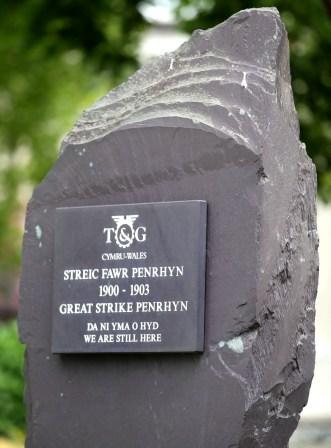
Great Strike Penrhyn Quarry memorial11-12919

The strike at Penrhyn Quarry, Bethesda in North Wales, which began on 22 November 1900 lasted for three years and is the longest dispute in British industrial history.

Quarrymen were forced to endure extremely hard and dangerous work for very low levels of pay.  They were also badly treated by their employers, who often regarded them as their own property and allowed them only Christmas Day off as a holiday.

Following disputes in 1825, 1864 and 1865, the North Wales Quarrymen’s Union was established in 1874 and achieved success that year in disputes at Penrhyn and the nearby Dinorwic Quarry. Circumstances were just that little bit better for the men but in 1896 the Penrhyn quarry workers were defeated in their battle for a minimum wage after staying out on strike for eleven months.

Aristocratic families owned all of the quarries in North Wales with Penrhyn in the hands of Lord Penrhyn. His family had at one time owned thousands of slaves on their Jamaican sugar plantations. They won huge compensation for ‘loss of income’ when slavery was abolished. They invested this in developing their slate quarries and improving Penrhyn Castle.

In 1900, its owners informed 2,800 Penrhyn quarry workers that trade union contributions were to be ended at the site. Conflict with supervising contractors led to 26 men being taken to court. After taking solidarity strike action the quarrymen returned to work only to discover that 800 of them no longer had any work after eight banks had been closed. Every worker left the quarry and despite the hardships an improved company offer was refused at Christmas 1900.

Trade union donations and a special fund organised by the Daily News helped alleviate some of the suffering but many children went crying to bed unfed, with women sobbing that they could not fill their mouths.  On 11 June 1901 the quarry was re-opened with the company inviting selected quarrymen to break the strike by offering them increased wages. Only 242 returned to work, where they were joined by a similar number of newly recruited inexperienced employees. One of those driven back to work by his desire to prevent his family starving was so heartbroken he subsequently hung himself.

Those who returned were considered traitors. Cards with the wording ‘Nid Oes Bradwr yn y Ty Hwn’ (There is no traitor in this house) were displayed in the strikers’ windows. Taking down a card was a sign that a worker had returned to work. Lord Penrhyn then built new homes for strikebreakers away from the centre of Bethesda. The strikers complained of ceaseless persecution and beatings by the police and a committee of inquiry appointed by Caernarvonshire County Council found that the police acted without regard to the liberties of those on strike. Attacks on strikers by those who had gone back to work were also left unpunished.

After three years on strike the desperate suffering of the strikers forced them to return to work on Lord Penrhyn’s terms. The victorious owner refused to re-employ the strike leaders and many subsequently left the area permanently to find work elsewhere.  The memorial to the strike was unveiled in Bethesda on 11 November 2000. This was organised by the Transport and General Workers Union (TGWU), who inherited the mantle of the Quarrymen’s Union when the organisations merged in the 1950s.  The TGWU is now part of Unite, which represents the current workers at Penrhyn quarry, which is today owned by the Welsh Slate Company.

To find out more on the dispute then buy WHAT I SAW AT BETHESDA – Charles Sheridan Jones, who was the special correspondent, sent by the Daily News to cover the unfolding drama and his articles were collected into this book, which was originally published in 1903. His are first-hand experiences of the misery and injustice suffered by the workers families, and of the cruelty of Lord Penrhyn’s methods.  £7.99 plus postage:-  http://www.gomer.co.uk/index.php/books-for-adults/history-and-culture/what-i-saw-at-bethesda.html

Michael Davitt, Haslingden

Davitt (25/03/1846 — 30/05/1906) was an Irish Republican and agrarian campaigner, who founded the Irish National Land League, which by aiming to abolish landlordism in Ireland sought to help tenant farmers by enabling them to own the land they worked on. Davitt was also a labour leader, Home Rule politician and MP.

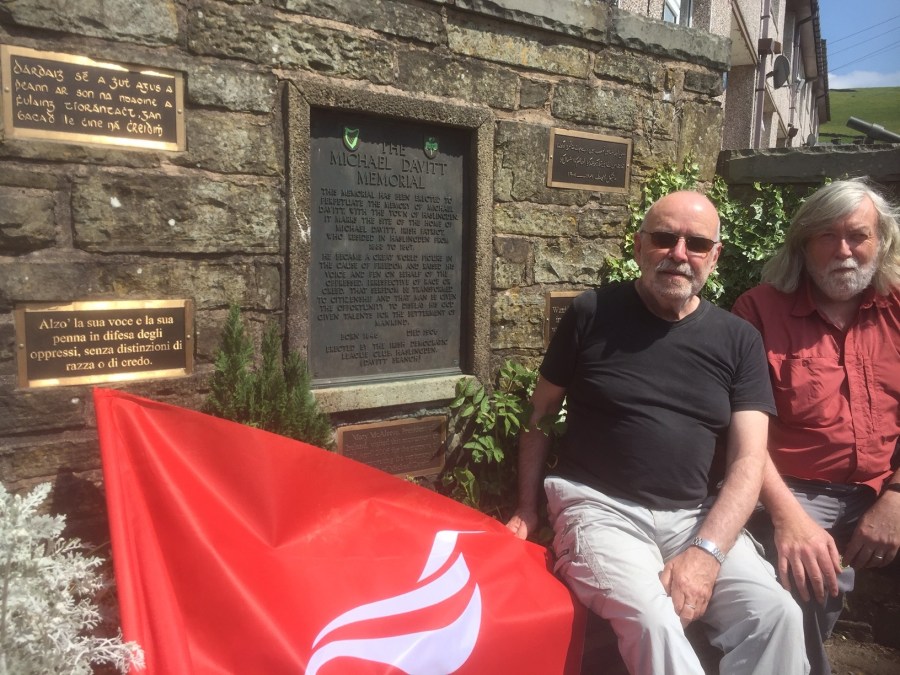
On Wilkinson Street in Haslingden in Rossendale, Lancashire there is a memorial to Michael Davitt at the site where his house used to be. The memorial was visited by Mary McAleese, President of Ireland, on 12 April 2006 to commemorate the centenary of the death of Davitt.
michael davitt memorial11-31310
land leagueThere is also a mural tablet commemorating Davitt at St Mary’s Church, Haslingden. This was unveiled in 1908. The Church organ was also given in memory of Davitt.

Just over the road from the memorial on Wilkinson Street is the Haslingden Davitt IDL Club; The Land League

There is also a Davitt Museum in a former church in Straide, Foxford, County Mayo, Ireland. Davitt was christened in the church.

To find out more about Michael Davitt then a good start would be Bryan Yorke’s excellent Haslingden Old and New blog here.

Many thanks to Unite Community members Tony Shaw and John Mooney for bringing to the attention of Rebel Road the Michael Davitt memorial.

Mechanics’ Institute – first TUC 1868

TUC plaque 111-32091

There is a plaque on the outside of the Mechanics’ Institute, Princess Street, Manchester where the first Trade Union Congress was held from 2-6 June, 1868. Built in 1854 as a centre for working class, adult education it offered a wide range of evening classes in English grammar, writing, reading, music, arithmetic, Latin and other languages. It was also the birthplace of the University of Manchester Institute of Science and Technology (UMIST) and the Cooperative Insurance Society. The building, which is Grade II listed now houses the Mechanics Institute Trust and is part of the Peoples History Museum.

Photograph: Tony Shaw, a Unite Community member from Mytholmroyd.

Stalybridge 1842 General Strike

Tameside 1842 Strike plaque 111-32092

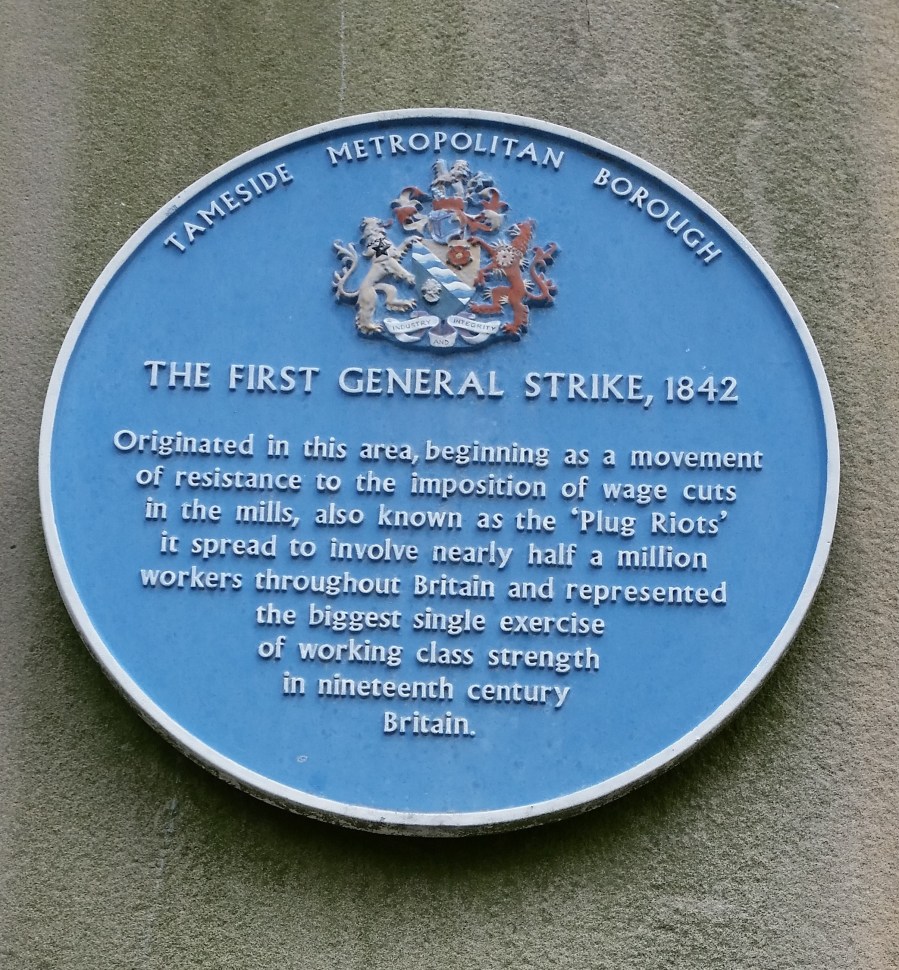
Located alongside the J R Stephens plaque on Stalybridge Town Hall frontage, this plaque commemorates the first general strike which originated in 1842 in this area.

It began as a movement of resistance to the imposition of wage cuts in the mills before it quickly expanded into a movement for universals male suffrage. It spread to involve nearly half a million workers throughout Britain and represented the biggest single exercise of working class strength in nineteenth century Britain.

Photograph: Tony Shaw, a Unite Community member from Mytholmroyd.