Category: General Blogs
THE HELL OF TREBLINKA – Vasily Grossman
Fascism does not start with extermination or death camps but the ideological core of its dictatorial beliefs in racial supremacy — combined with a totalitarian one-party government system that allows no dissent — will inevitably result in the creation of such horrendous institutions.
It was the discovery of Nazi concentration camps towards the end of WWII that revealed the true horror of the Holocaust, the genocide by which Adolf Hitler’s National Socialists, aided by its collaborators, systematically murdered in excess of six million European Jews and hundreds of thousands of its political opponents, disabled people, lesbians and gay men as well others such as Romany people who it viewed as inferior or a threat.
Treblinka, built in occupied Poland, was one of many extermination camps. An estimated 700,000 plus Jewish people were, between July 1942 and October 1943, slaughtered there in its gas chambers as part of what the Nazi regime referred to as the Final Solution.
The decision to abruptly bring to an end a highly efficient operation in which thousands were killed daily was the result of continuing victories on the Eastern Front by the Soviet Union Red Army, which, with the loss of 11 million soldiers, had from 1941 onwards born the brunt of the Nazi war machine.
Faced with the possibility of the whole world getting to know what they had been doing, Heinrich Himmler, the head of the paramilitary organisation the SS, arrived at the camp in early 1943. Like Hitler, Himmler was a fervent anti-Semite and he stood for sometime admiring the outcome of his instructions by looking down on the corpses of thousands of innocent people that were on open display in giant pits. Before he left he made it clear that from now on all those that were killed — plus those who had already gone, all slaughtered within hours of their arrival — should be burnt. He wanted rid of all the evidence.
Huge furnaces were constructed to create giant grill pits where the heat was often so intense that those who threw the dead bodies into the flames were themselves overcome by the fumes and fell to their deaths. Some preferred to commit suicide rather than be consumed by their guilt in the whole horrendous exercise.
But how do we know this? It is because despite the Germans blowing up Treblinka, but only after they were unable to successfully suppress and prevent the escape of at least some of the condemned prisoners in August 1943, the Red Army entered the well hidden camp.
Accompanying the fighters was journalist Vasily Grossman. He systematically researched what had happened there through his own observations, reading documents that had survived and by speaking and arranging interviews with survivors, local people and those involved, in many different ways, in the processes that resulted in the mass murder of so many people.
It is difficult to come to terms with the brutality that is described in this short book of 60 pages. What is also difficult to comprehend is the subtle methods that were devised by the fascist regime to hoodwink people such that the large majority only comprehended that they were being led to their deaths in the final few minutes of their lives.
That was not though always the case and the book contains descriptions of some heroic acts of co-ordinated resistance amongst prisoners who had survived being killed on arrival at Treblinka because they had special skills to minister to the Germans’ everyday needs.
There are also numerous small individual acts of humanity portrayed such as dying mothers trying to give some small relief in the last few moments of their own lives to their children as they lay next to one another gasping for breath in the gas chambers where the death process took from ten to twenty-five minutes. Sadly, we will never know many of the names of those who fought so bravely. But the eventual defeat of fascism in 1945 was as much a victory for them as those that survived.
This is not an easy book, but EVERY HUMAN BEING SHOULD READ THIS BOOK.
Death to fascism.
WHAT IS FASCISM?
Please note this is not the defined position of Unite the union but has been compiled by Mark Metcalf.
Under fascism all forms of democracy including autonomous workers organisations are annihilated.
A state control system is then created at preventing fascism ever being overthrown. Individual identity is crushed insofar as the individual simply exists to serve the interests of the state.
Fascism began as a movement at the start of the twentieth century in response to rapid social upheaval, the slaughter of millions in World War One and the 1917 Russian revolution.
Fascism glorifies the nation and/or race as transcending all other loyalties. Myths of national or racial rebirth are emphasised following periods of decline or destruction. Fascism thus aims to destroy ‘outside’ or ‘alien’ forces that threaten the nation and/or race.
Fascism thus generally promotes racial and male supremacy doctrines and ethnic persecution and it also has a history of genocide and imperialist expansion.
As fascism seeks to gain power its political approach is twofold. It is populist, seeking to activate the ‘whole people’ against perceived enemies, such as Jewish people, or oppressors. It is also elitist, whereby ‘the peoples will’ is embodied in a select group, or more generally in one supreme leader and from whom authority proceeds downward. As such fascism is not only about superiority between races but within races.
Fascism is hostile to socialism, liberalism and conservatism, whilst adopting concepts from all three.
Fascism rejects class struggle and workers internationalism on the grounds that they threaten national or racial unity. Fascism does though frequently exploit genuine grievances against capitalists and landowners by developing radical sounding conspiracy theories and ethnic scapegoating.
Although fascism may use Parliamentary methods to try and gain power it rejects political pluralism and representative government. Fascism can clash with conservatives, who are attached to tradition based institutions, and yet fascism generally romanticises the past in order to promote or provide inspiration for national rebirth.
Fascism’s relationship with established elites can be complex. In general, fascism defends and promotes capitalism but it can also seek to exploit differences within the ruling class as it seeks to subsume capitalism under the umbrella of the nation state. Cooperation, competition and interaction between fascism and other right wing groups has produced hybrid movements and regimes.
Examples of fascist regimes from the past are Nazi Germany under Adolf Hitler and Italy under Benito Mussolini. Both men destroyed the trade union movement as they moved to take complete control of society. In Britain, Oswald Mosley’s British Union of Fascists, the National Front, British National Party and English Defence League have sought to develop support for fascism.
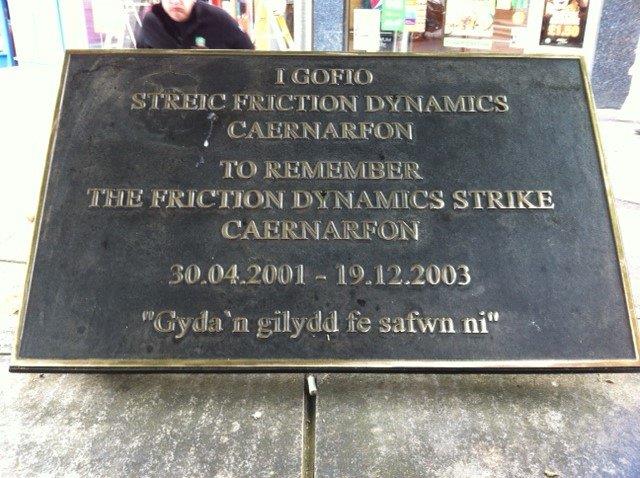
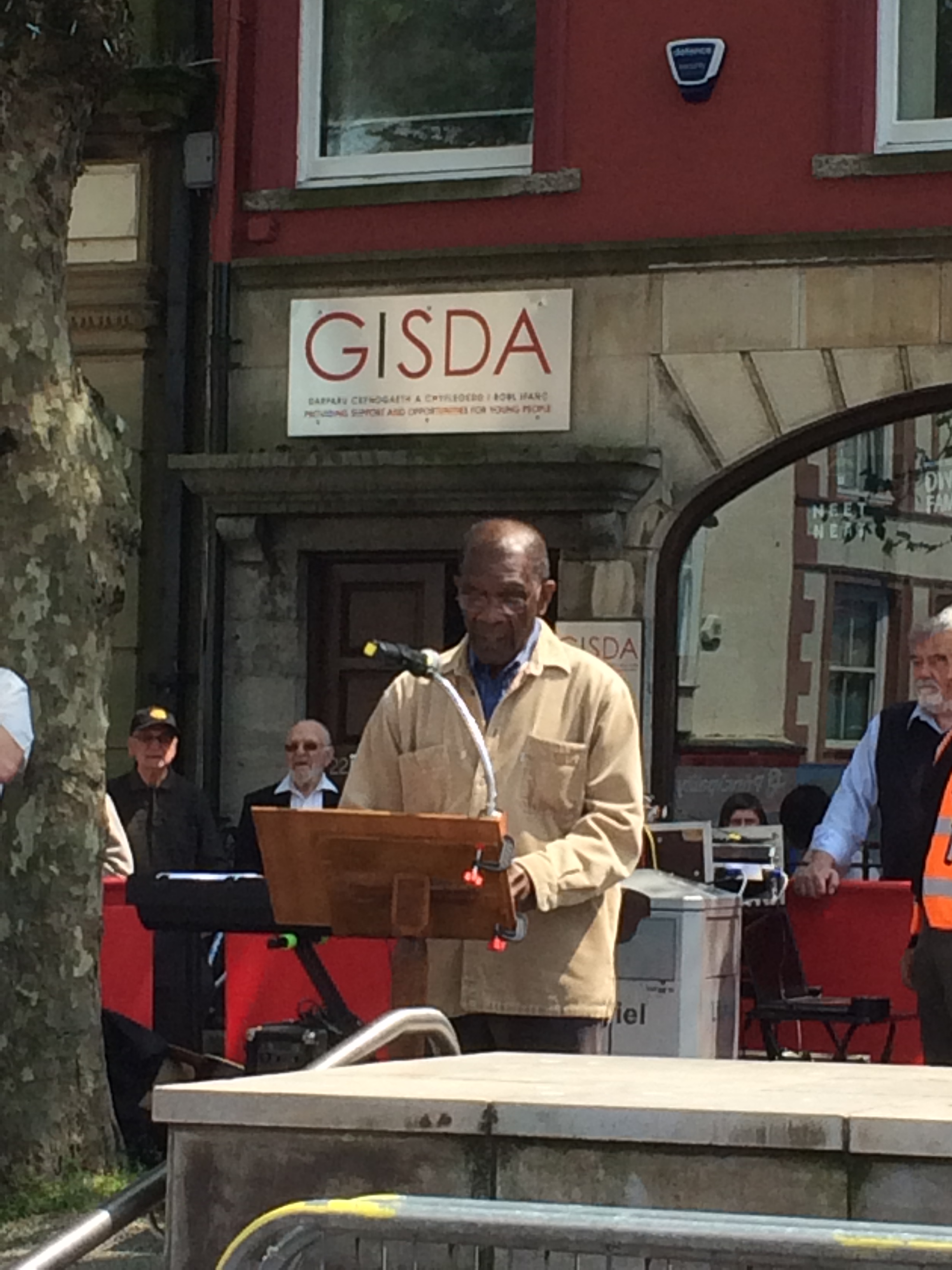
A plaque in Gwynned, North Wales commemorates one of the longest (*) industrial disputes in British history.
Feredo, which manufactured brake parts for the motoring industry, was renamed Friction Dynamics in 1997 by its new owner, American Craig Smith. With 220 workers the factory employed just slightly more than a tenth of its original workforce in 1962.
Smith was intent on making radical changes to working conditions that included pay cuts and changes to shifts. After following the legal procedure laid down by Parliament, in April 2001, Transport and General Workers’ Union (TGWU) members began an official strike of one week at the end of which TGWU members set off to return to work, where they were met at the gate by management who demanded that they sign new contracts. When everyone refused to sign the company effectively locked out the workers before sacking them.
Strike action then began and picketing of the factory started, leading to a three-year dispute. In October 2002, an employment tribunal backed the 86 dismissed workers by ruling they had been unfairly dismissed but no compensation was paid — at anytime — when the company called in the receivers. The factory is today derelict.
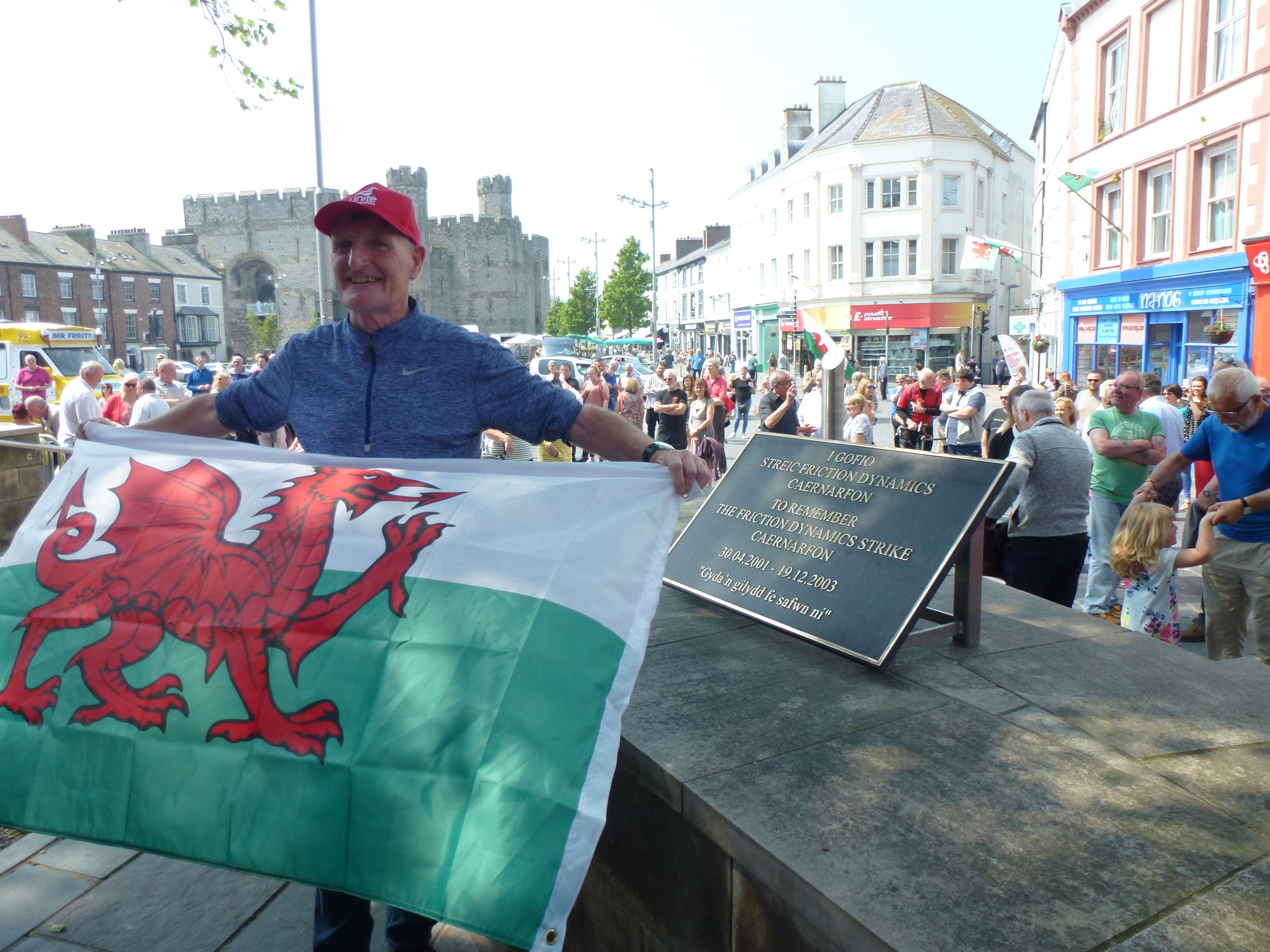
“ The idea to commemorate the strike was originally proposed by Alun Roberts,” explains striker John Davis, “who approached us saying the community believe there should be something to remember it.
“Alun had just retired as a junior school headmaster in Caernarfon when the strike began. He was active within Plaid Cymru, we worked with all the parties throughout the dispute, like everyone he was disgusted by the attitude of the owner.
“Following Alun’s approach a committee was formed and I was surprised as we successfully set about raising funds for a commemorative plaque just how few young people even knew there had been a dispute.
“The plaque has been placed in a spot where it cannot be missed. It has renewed the interest in the strike. People know how things have developed in the 20 years since the strike and are aware of the situation for workers with zero hours contracts, no sick pay and few permanent jobs. We predicted this – Us today, you tomorrow — when we were on strike as that was what the owner was seeking to do.
“To think we had a Labour government at the time with the biggest majority ever and they did nothing about it. They could have made some dramatic changes to workers’ rights and things would be better now for younger people.
“The plaque reminds people of the strike and all the strikers were pleased to see Gerald Parry unveil it. We are currently working on developing a website that tells the whole history of the strike and lock out. It will include the support we had within the UK and internationally. “
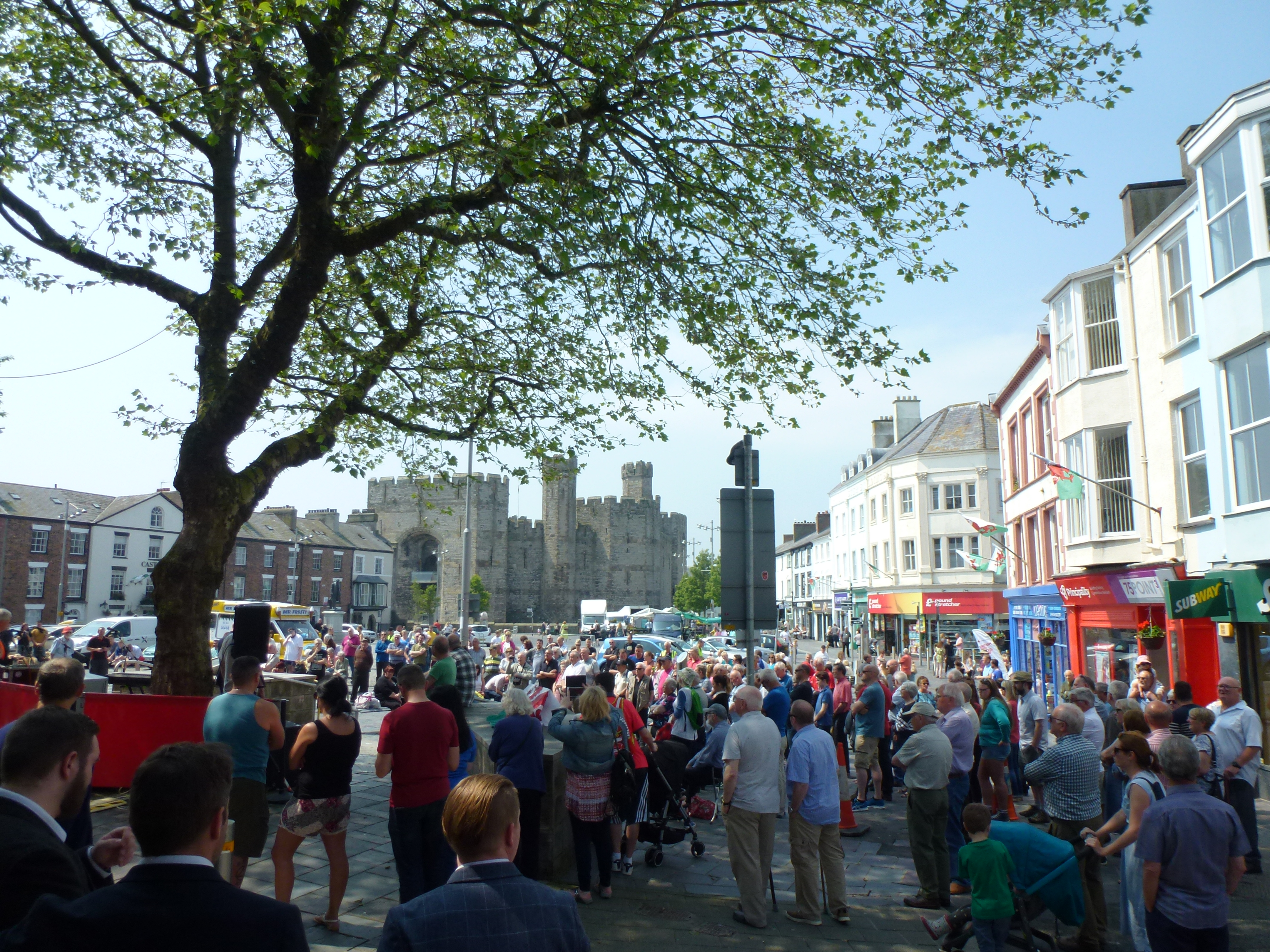
Many thanks to Robin Evans for allowing the use of all four photographs.
John Davis was employed at Feredo and later Friction Dynamics from 1976 onwards and as the face of the strike he found it very difficult to find work. He was unemployed for five years before setting up with two colleagues a co-operative, Red Line Indoor Karting, which has now been going for over 12 years. http://www.redlineindoorkarting.co.uk
- There’s little doubt that once risen the Welsh people are determined — see https://markwrite.co.uk/2018/06/14/the-great-strike-at-penryhn-quarry-1900-03/ The strike at Penrhyn Quarry, Bethesda in North Wales, which began on 22 November 1900 lasted for three years and is the longest dispute in British industrial history.
Former TGWU leader Bill Morris unveiled in May 2018 a plaque in Gwynedd, North Wales that commemorates one of the longest-running (*) industrial disputes in British history.
Bill Morris at the unveiling
Fredo, which manufactured brake parts for the motoring industry, was renamed Friction Dynamics in 1997 by its new owner, American Craig Smith. With 220 workers the factory employed just slightly more than a tenth of its original workforce in 1962.
Smith was intent on making radical changes to working conditions that included pay cuts and changes to shifts. In April 2001, Transport and General Workers’ Union members began strike action to defend their terms and conditions and picketing of the factory started. Bosses then sacked the union members, leading to a three-year dispute. In October 2002, an employment tribunal backed the 86 dismissed workers by ruling they had been unfairly dismissed but no compensation was paid — at anytime — when the company called in the receivers. The factory is today derelict.
“ The idea to commemorate the strike was originally proposed by Alun Roberts,” explains striker John Davis, “who approached us saying the community believe there should be something to remember it.
“Alun had just retired as a junior school headmaster in Caernarfon when the strike began. He was active within Plaid Cymru, we worked with all the parties throughout the dispute, like everyone he was disgusted by the attitude of the owner.
“Following Alun’s approach a committee was formed and I was surprised as we successfully set about raising funds for a commemorative plaque just how few young people even knew there had been a dispute.
“The plaque has been placed in a spot where it cannot be missed. It has renewed the interest in the strike. People know how things have developed in the 20 years since the strike and are aware of the situation for workers with zero hours contracts, no sick pay and few permanent jobs. We predicted this – Us today, you tomorrow — when we were on strike as that was what the owner was seeking to do.
“To think we had a Labour government at the time with the biggest majority ever and they did nothing about it. They could have made some dramatic changes to workers’ rights and things would be better now for younger people.
“The plaque reminds people of the strike and all the strikers were pleased to see Bill Morris unveil it. We are currently working on developing a website that tells the whole history of the strike and lock out. It will include the support we had within the UK and internationally. “
Many thanks to Robin Evans for allowing the use of all four photographs.
John Davis was employed at Feredo and later Friction Dynamics from 1976 onwards and as the face of the strike he found it very difficult to find work. He was unemployed for five years before setting up with two colleagues a co-operative, Red Line Indoor Karting, which has now been going for over 12 years. http://www.redlineindoorkarting.co.uk
- There’s little doubt that once risen the Welsh people are determined — see https://markwrite.co.uk/2018/06/14/the-great-strike-at-penryhn-quarry-1900-03/ The strike at Penrhyn Quarry, Bethesda in North Wales, which began on 22 November 1900 lasted for three years and is the longest dispute in British industrial history.
Joan Maynard MP 1921 -1998
Sowerby, North Yorkshire
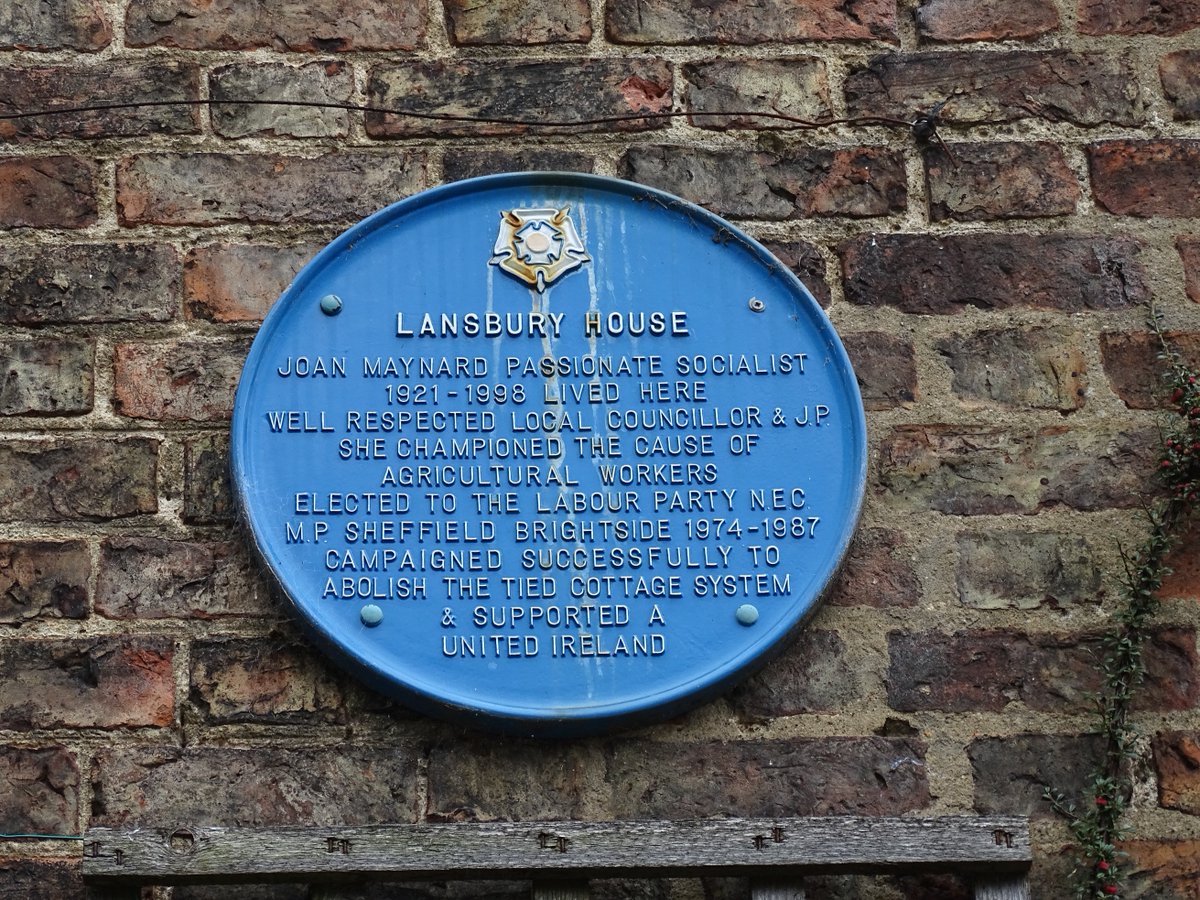
There is a plaque to Joan Maynard MP at her former Sowerby home — known as Lansbury House – in North Yorkshire. She died there aged 76 in 1998 and seven years later her close friend, Labour MP Chris Mullin, unveiled the plaque.
Maynard’s passion for politics was inherited from her father, Matt, who named his house after life long socialist George Lansbury, the Labour Party leader from 1931 to 1935.
During WWII, Joan received less for delivering the post than the postman who was called up for active service. It was her first experience of unequal pay for women. She got involved in politics during the 1945 General Election at which Labour secured a handsome majority.
There was at the time no Thirsk Labour Party and Joan thus established a local branch and became its first secretary. She joined the agricultural workers’ union, being appointed Yorkshire County secretary in 1954. In between, her political career had been forged, winning seats on the district council and county council. She became Sheffield Brightside MP in 1974. She served for 13 years.
At Westminster she became a notable rebel, supporting controversial causes, such as the Troops Out Movement that campaigned for British withdrawal from Northern Ireland and United Ireland. As a champion of the rural poor, she used her position in Parliament to fight for an end to the power of farmers and rural landholders to evict farm labourers under tied cottage legislation. She was central to the passing of the Rent (Agriculture) Act 1976.
Many thanks to Dr. Claire Tupling for this photograph. @TupsTweets


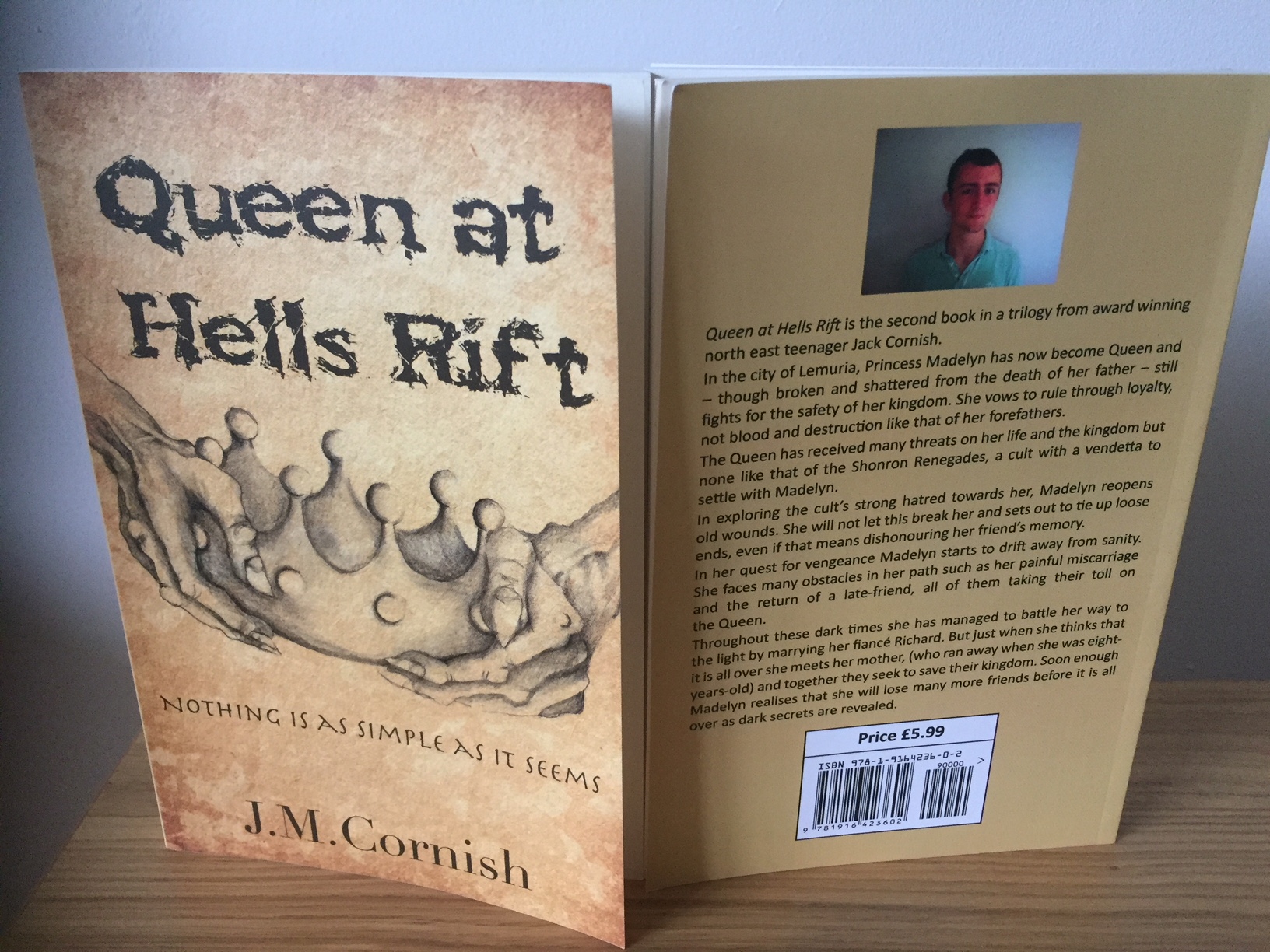
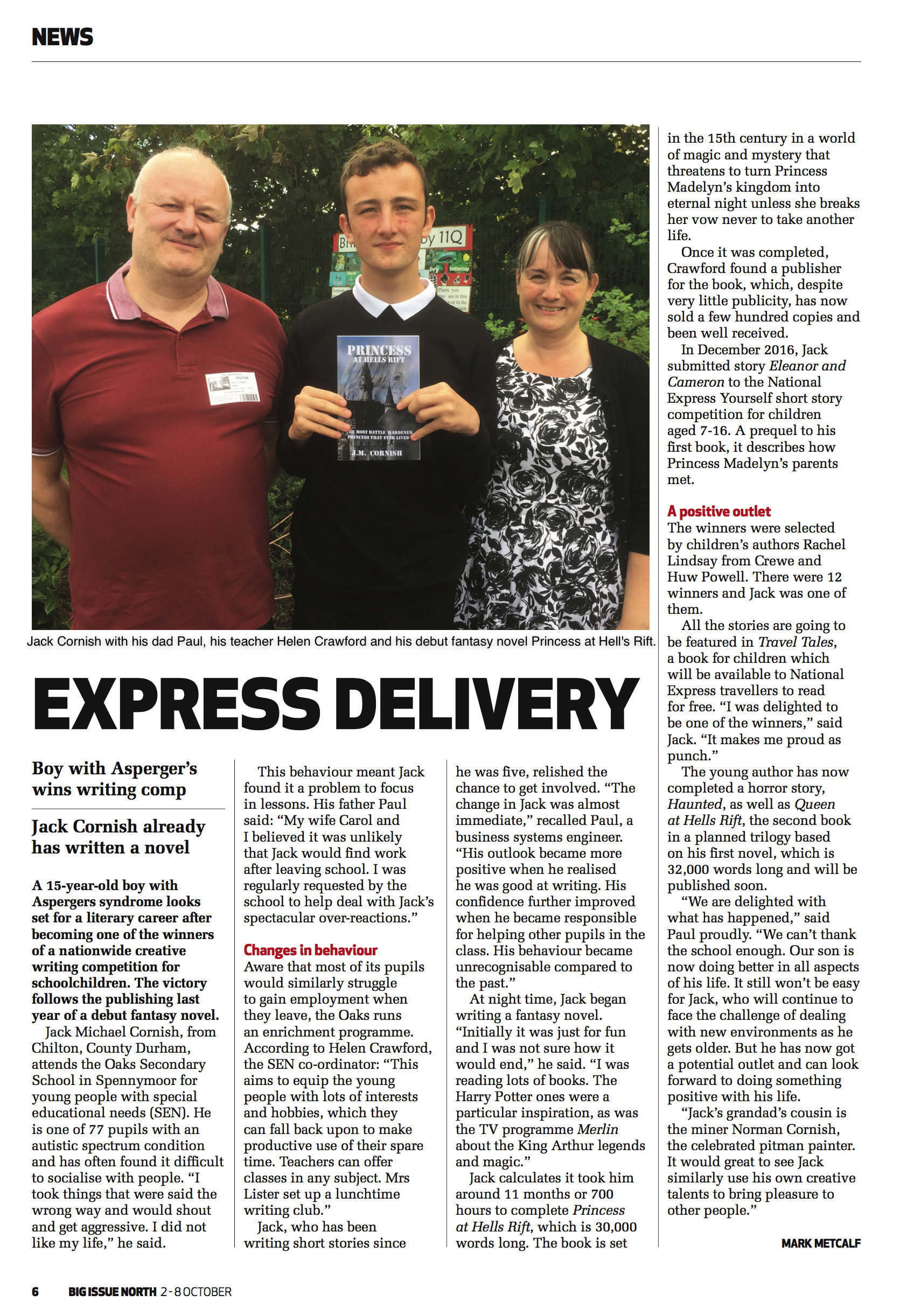
Jack is a young lad from the North East who is overcoming his autism to forge a creative career. He urgently needs an agent to help take him on to the next level. Please contact me if you are an agent and would like to find out more. Queen at Hells Rift was released in August 2018. If you would like to purchase a copy of the book at £5.99 then email paul.cornish@email.com
 Mark Metcalf ~ independent working class writer and journalist